If You Also Hold the S&P 500, AI, and Semiconductors
Translated from Chinese by AITap a paragraph to see it in 中文
AI summary
Mapping out potential risk factors for the S&P 500 and AI semiconductors, focusing on capex guidance, depreciation pressure, and gross margin mean reversion, while warning against severe drawdowns after index surges.
Not investment advice
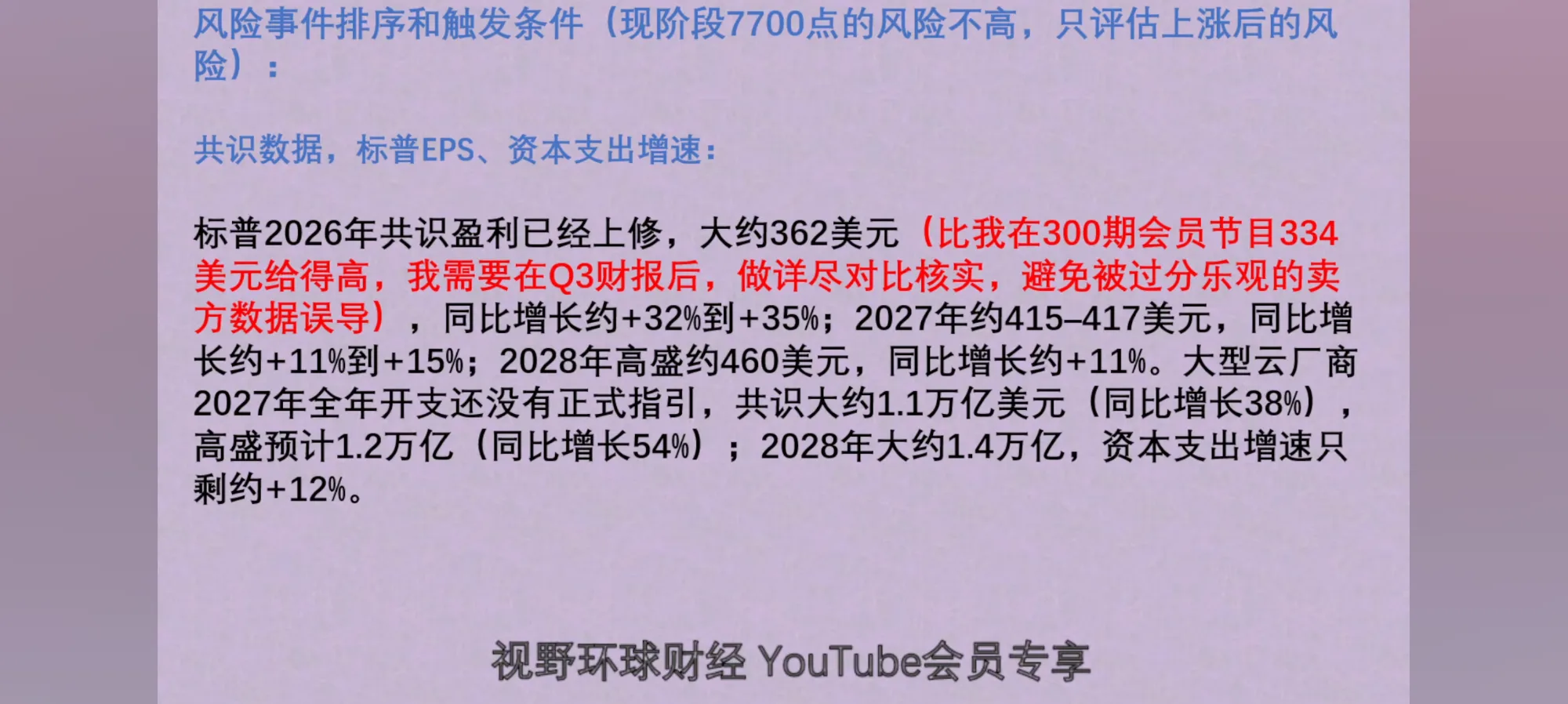
Ranking of risk events and triggering conditions (at the current 7,700-point level, risk is not high; only assessing the risks after further gains):
Consensus data, S&P EPS, and CapEx growth rates:
Consensus earnings for the S&P in 2026 have already been revised upward to around $362 (higher than the $334 I gave in Episode 300 of the members-only program; I need to do a detailed comparative verification after the Q3 earnings reports to avoid being misled by overly optimistic sell-side data), representing a year-over-year increase of about +32% to +35%; 2027 is around $415–$417, up about +11% to +15% YoY; for 2028, Goldman Sachs projects around $460, up about +11% YoY. There is no official guidance yet on full-year 2027 CapEx for major hyperscalers—consensus sits around $1.1 trillion (+38% YoY), while Goldman expects $1.2 trillion (+54% YoY); for 2028, it is around $1.4 trillion, with CapEx growth dropping to just about +12%.
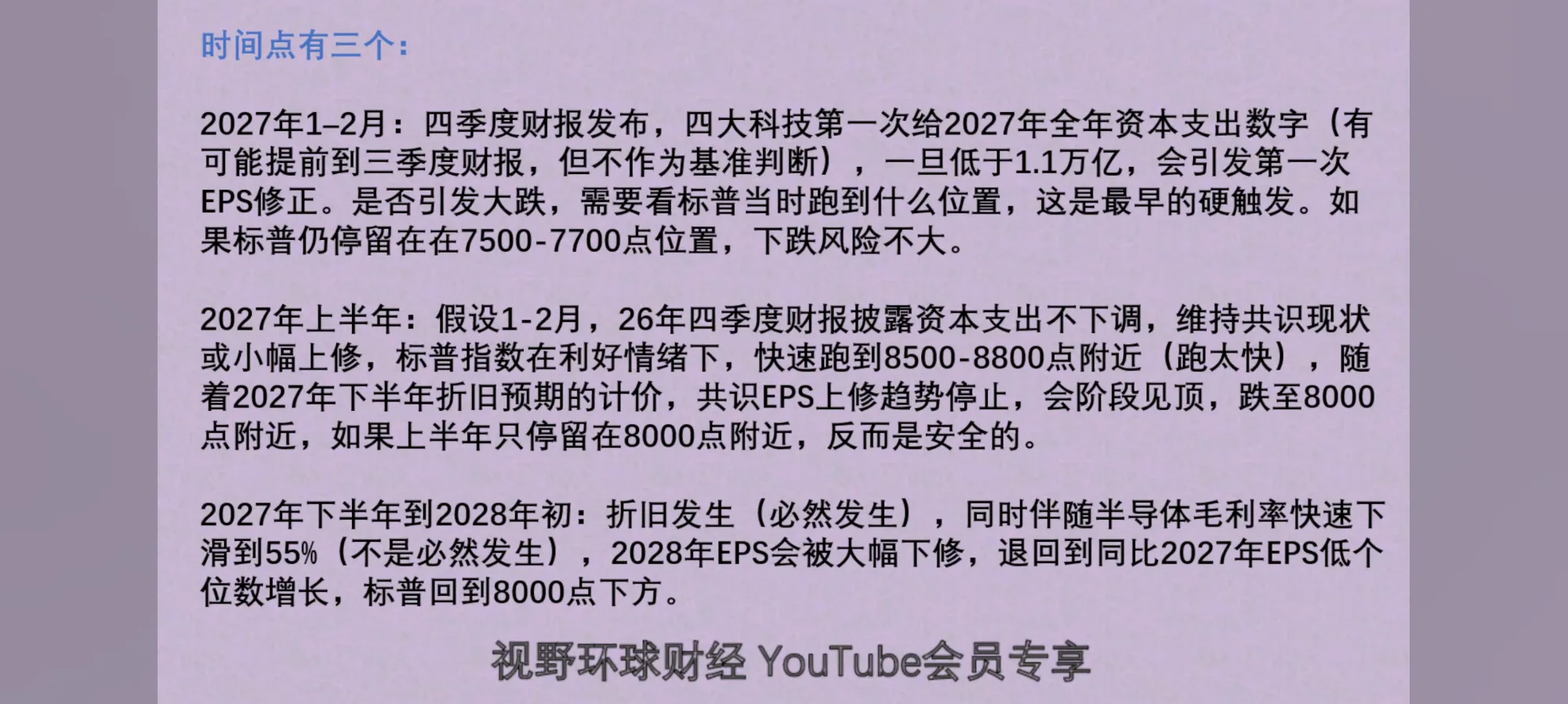
There are three key time points:
January–February 2027: Q4 earnings releases, when the Big Four tech giants will provide full-year 2027 CapEx figures for the first time (this could potentially be moved up to Q3 earnings, but is not the baseline assumption). Once it comes in below 1.1 trillion, it will trigger the first EPS downward revision. Whether this sparks a major sell-off depends on where the S&P is trading at the time; this is the earliest hard trigger. If the S&P remains parked in the 7,500–7,700 range, downside risk is modest.
First half of 2027: Assuming that in January–February, Q4 2026 earnings reports reveal no downward revision to CapEx—maintaining consensus or slightly upgrading it—the S&P 500 quickly surges to around 8,500–8,800 driven by bullish sentiment (running too fast). As depreciation expectations for the second half of 2027 get priced in, the upward trend in consensus EPS will stall, forming an interim peak before pulling back to around 8,000. If it merely stays near 8,000 throughout the first half, that would actually be safe.
Second half of 2027 to early 2028: Depreciation sets in (a certainty), accompanied by semiconductor gross margins dropping sharply to 55% (not a certainty); 2028 EPS would then face substantial downward revisions, slowing to low single-digit YoY growth compared to 2027, sending the S&P back below 8,000.
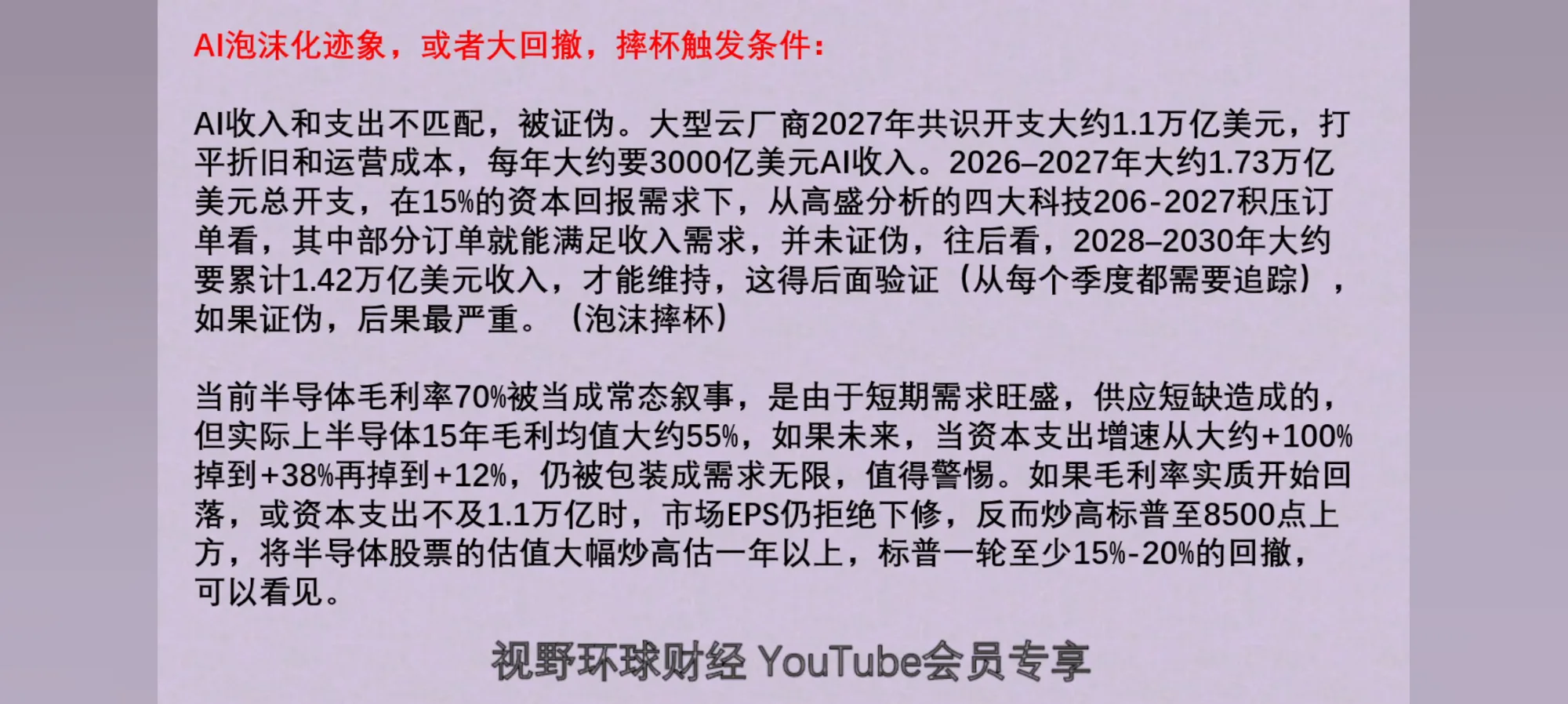
Signs of an AI bubble, or conditions triggering a major pullback / bubble-bursting moment:
AI revenues and expenditures fail to match and get debunked. Consensus 2027 CapEx for major hyperscalers is around $1.1 trillion; breaking even on depreciation and operating expenses requires about $300 billion in annual AI revenue. With total CapEx of about $1.73 trillion over 2026–2027, under a required 15% return on capital, Goldman Sachs's analysis of the Big Four's 2026–2027 order backlogs suggests that just a portion of these backlogs can meet the revenue requirement, meaning it has not been debunked yet. Looking further ahead, a cumulative revenue of roughly $1.42 trillion will be needed over 2028–2030 to sustain this, which remains to be verified (requiring tracking every quarter); if debunked, the fallout will be most severe (a bubble-bursting drop).
Current semiconductor gross margins of 70% are being treated as the normal narrative, driven by robust short-term demand and supply shortages. In reality, the 15-year historical average gross margin for semiconductors is around 55%. If CapEx growth decelerates in the future from around +100% down to +38% and then to +12%, yet continues to be packaged as infinite demand, caution is warranted. If gross margins begin a substantive pullback, or CapEx falls short of 1.1 trillion, while market EPS estimates still refuse to be revised downward—instead pushing the S&P above 8,500 and heavily overvaluing semiconductor stocks for more than a year—a pullback of at least 15%–20% in the S&P is clearly foreseeable.
Vision Global Finance YouTube Members Exclusive